Showing posts with label Antarctic sea ice. Show all posts

Sunday, November 1, 2015

NASA study: Antarctica gaining ice...

Al Gore and Barack Obama hardest hit...

Via UPI:
According to a new NASA study, ice sheet gains outweigh losses on the Antarctic continent. The findings conflict with those of the Intergovernmental Panel on Climate Change, which in 2013 suggested gains were not keeping up with losses.
The new study, published in the Journal of Glaciology, doesn’t totally undermine the handful of studies showing significant glacier, ice sheet and sea ice shrinkage. Instead, if offers evidence of previously unaccounted gains.
The new tallies reveal an annual net gain of 112 billion tons between 1992 and 2001. Annual gains of 82 billion tons were observed between 2003 and 2008…

Thursday, September 17, 2015

Antarctic sea level at 35 year high...

Via Washington Post:
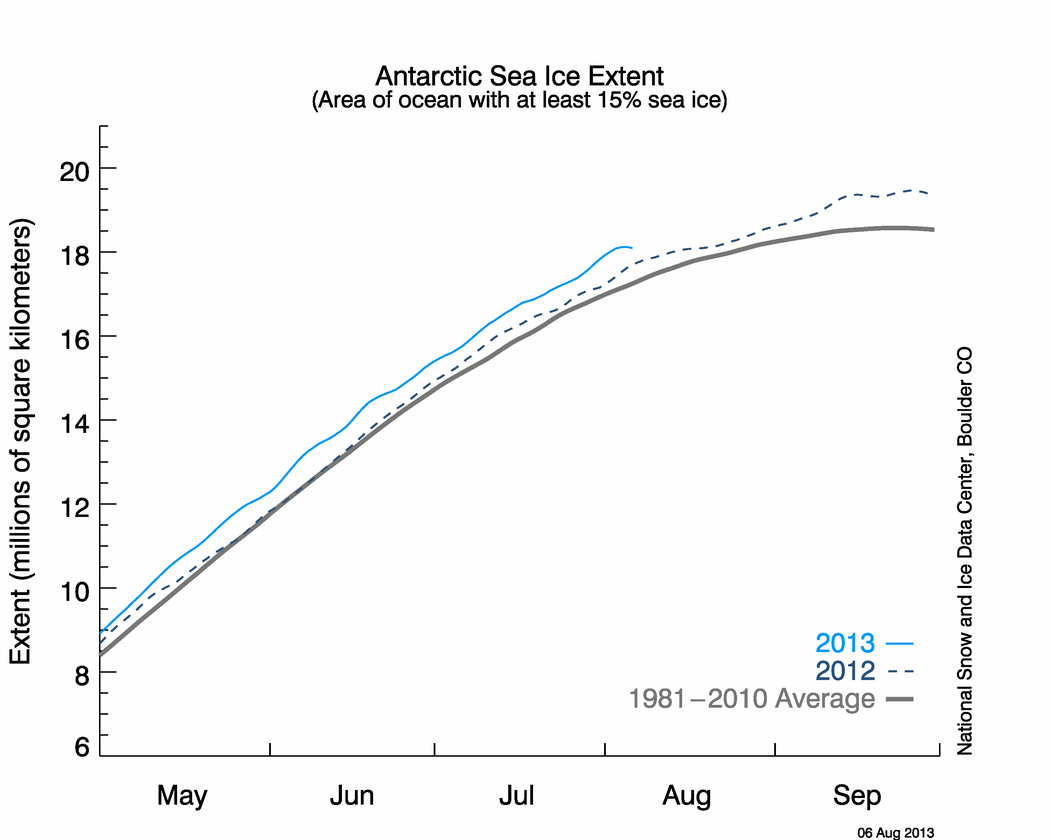
Antarctic sea ice has grown to a record large extent for a second straight year, baffling scientists seeking to understand why this ice is expanding rather than shrinking in a warming world.
On Saturday, the ice extent reached 19.51 million square kilometers, according to data posted on the National Snow and Ice Data Center Web site. That number bested record high levels set earlier this month and in 2012 (of 19.48 million square kilometers). Records date back to October 1978.
Keep on reading…

Tuesday, November 25, 2014

Not only is Antarctica's sea ice expanding, it is thicker than previously thought...

Global warming alarmists claimed although it might be expanding, the ice was very thin. They are wrong again.

Via Live Science:
Antarctica's ice paradox has yet another puzzling layer. Not only is the amount of sea ice increasing each year, but an underwater robot now shows the ice is also much thicker than was previously thought, a new study reports.
The discovery adds to the ongoing mystery of Antarctica's expanding sea ice. According to climate models, the region's sea ice should be shrinking each year because of global warming. Instead, satellite observations show the ice is expanding, and the continent's sea ice has set new records for the past three winters. At the same time, Antarctica's ice sheet (the glacial ice on land) is melting and retreating.
Measuring sea ice thickness is a crucial step in understanding what's driving the growth of sea ice, said study co-author Ted Maksym, an oceanographer at the Woods Hole Oceanographic Institution in Massachusetts. Climate scientists need to know if the sea ice expansion also includes underwater thickening. [Album: Stunning Photos of Antarctic Ice]

Wednesday, October 8, 2014

Antarctic sea ice hits another record level...

NASA says the sea ice record reflects the diversity and complexity of Earth’s environments. I say it represents a fail of the global warming models. I don't believe they predicted this change.

Via NASA:
Sea ice surrounding Antarctica reached a new record high extent this year, covering more of the southern oceans than it has since scientists began a long-term satellite record to map sea ice extent in the late 1970s. The upward trend in the Antarctic, however, is only about a third of the magnitude of the rapid loss of sea ice in the Arctic Ocean.
The new Antarctic sea ice record reflects the diversity and complexity of Earth’s environments, said NASA researchers. Claire Parkinson, a senior scientist at NASA’s Goddard Space Flight Center, has referred to changes in sea ice coverage as a microcosm of global climate change.
Just as the temperatures in some regions of the planet are colder than average, even in our warming world, Antarctic sea ice has been increasing and bucking the overall trend of ice loss.

Friday, July 4, 2014

Change: Warmists now claim global warming is causing South Pole sea ice to grow...

Is there anything global warming can't do? 
Earlier this year, global warming was blamed for the ‘irreversible retreat’ of west Antarctic glaciers.
But now scientists claim that warming of the planet is in fact behind a paradoxical growth in South Pole sea ice.
The comments come as Antarctica’s sea ice set a record this week, reaching 815,448 square miles (1,312,000 square km) of ice above its normal range.
Scientists believe the shift is caused by water melting from beneath the Antarctic ice shelves and re-freezing back on the surface.
‘The primary reason for this is the nature of the circulation of the Southern Ocean — water heated in high southern latitudes is carried equatorward, to be replaced by colder waters upwelling from below, which inhibits ice loss,’ Mark Serreze, director of the National Snow and Ice Data Centre, told Harold Ambler at Talking About the Weather.
However, as reported in a separate blog post by Mr Ambler, Nasa scientist Walt Meier said that growing Antarctic sea ice coverage is less significant a measure than declining Arctic sea ice coverage when assessing climate change.
Last year, a team from the Royal Netherlands Meteorological Institute found that the fresh water melting from the Antarctic ice sheets had a relatively low density compared to the denser salty seawater.
This means that the water accumulates and freezes in the top layer of the ocean during the summer months.
Surrounded by North America, Greenland and Eurasia, the Arctic ice cap floats on the ocean, not land. It has lost a large amount of its older, thicker sea ice over the last 30 years, making it more vulnerable to the warming trend.

Friday, June 13, 2014

West Antarctic glacier collapsing due to geothermal heat?

Somehow volcanoes will be blamed on global warming or George Bush. Take your pick.

Via The daily Caller:
new study by researchers at the University of Texas, Austin found that the West Antarctic Ice Sheet is collapsing due to geothermal heat, not man-made global warming.
Researchers from the UTA’s Institute for Geophysics found that the Thwaites Glacier in western Antarctica is being eroded by the ocean as well as geothermal heat from magma and subaerial volcanoes. Thwaites is considered a key glacier for understanding future sea level rise.
UTA researchers used radar techniques to map water flows under ice sheets and estimate the rate of ice melt in the glacier. As it turns out, geothermal heat from magma and volcanoes under the glacier is much hotter and covers a much wider area than was previously thought.
“Geothermal flux is one of the most dynamically critical ice sheet boundary conditions but is extremely difficult to constrain at the scale required to understand and predict the behavior of rapidly changing glaciers,” UTA researchers wrote in their study, which was published in the Proceedings of the National Academy of Sciences.


Tuesday, December 31, 2013

Some on global warming research ship stuck in Antarctic ice to be rescued by helicopter...

What? The ice isn't melting?

Via The Mercury:
The Australian icebreaker Aurora Australis today failed in its second attempt to free the Russian-registered ship -- which has been stuck since Christmas Day with 76 people aboard.
"The Australian Maritime Safety Authority's Rescue Co-ordination Centre was advised this morning by the Aurora Australis that the ship will not be able to reach the MV Akademik Shokalskiy," AMSA said in a statement.
"The Aurora Australis advised RCC Australia it would be at risk of becoming beset by ice itself if it continued to make further rescue attempts."
The latest weather forecast for the area is of possible heavy snow and rain as well as possible fog and poor visibility.
The AMSA spokeswoman said 52 scientists and passengers would be evacuated from the ship in a helicopter based with the Chinese ice breaker Xue Long.

Tuesday, April 2, 2013

Anthropogenic global warming believers blame global warming for Antarctica’s sea ice increase...

Is there anything global warming can't do? 

The BBC reported:
Climate change is expanding Antarctica’s sea ice, according to a scientific study in the journal Nature Geoscience.
The paradoxical phenomenon is thought to be caused by relatively cold plumes of fresh water derived from melting beneath the Antarctic ice shelves.
This melt water has a relatively low density, so it accumulates in the top layer of the ocean.
The cool surface waters then re-freeze more easily during Autumn and Winter.
This explains the observed peak in sea ice during these seasons, a team from the Royal Netherlands Meteorological Institute (KNMI) in De Bilt says in its peer-reviewed paper.
Climate scientists have been intrigued by observations that Antarctic sea ice shows a small but statistically significant expansion of about 1.9% per decade since 1985, while sea ice in the Arctic has been shrinking over past decades.

Thursday, August 23, 2012

ICE agents sue Obama administration to be allowed to enforce the law

President Obama is forcing ICE agents to violate their own oaths of office...

Via Washington Times:
Saying they’re fed up with being told they can’t do their jobs, 10 immigration agents on Thursday sued the Obama administration to try to halt the president’s new non-deportation policy and an earlier memo instructing them not to go after rank-and-file illegal immigrants.

The lawsuit, filed in a federal court in Texas, adds a legal controversy to the political fight that has been brewing over President Obama’s immigration policies, which have steadily narrowed the range of immigrants the government is targeting for deportation.

The 10 U.S. Immigration and Customs Enforcement (ICE) agents and deportation officers said Mr. Obama’s policies force them to choose between enforcing the law and being reprimanded by superiors, or listening to superiors and violating their own oaths of office and a 1996 law that requires them to demand proof of legal status from those they suspect are not in the country legally.

Saturday, December 12, 2009

Are the Polar Caps Really Melting Due To Global Warming?

No. We came out of a 'little ice age' around 1850 and the temperature has increased slightly due to this, but nothing abnormal is happening. Global warming alarmists will tell you the polar caps are melting. This isn't exactly true. The University of Illinois keeps the sea ice data. As you can see from the chart below, Arctic ice is decreasing.

However, Antarctic ice is currently increasing.

When you combine the two charts into a global sea ice chart, you can see sea ice has been very stable for the last 150 years.

(Click charts for larger view)